Open Today Sales: 9 AM-8 PMOpen Today Service: 7:30 AM-8 PM

Purchasing a sedan means finding a premium travel companion; with our Volkswagen Jetta vs. Toyota Corolla comparison, you can see how both models stack up against one another. Both vehicles provide a similar silhouette for your garage, but only one offers more rear-row legroom, a larger trunk, and more features up front: the Volkswagen Jetta. Read on to see how a Jetta vs. Corolla comparison plays out, then visit Gunther Volkswagen Fort Lauderdale to see how the winner looks firsthand.
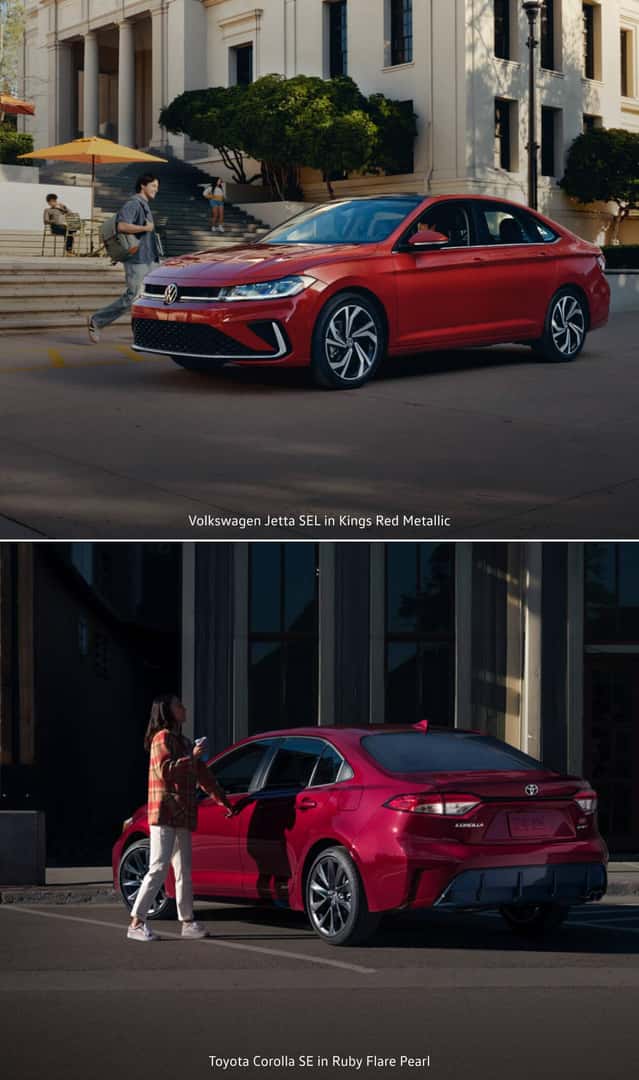
Let's begin by discussing how easy it is to customize these models to your preferred combination of features and style. The Toyota Corolla certainly provides some resistance: despite having six total trims, only three are gas-only, with the rest being the same trims using a hybrid engine.
The new Jetta trims are much less confusing in comparison, with just four levels to choose from:
The Toyota Corolla does have a strong list of perks, but many of them are beyond its core LE. The standard Corolla has a 7-inch instrument cluster, for example, and requires upgrading to the XLE to grow to a 12.3-inch cluster (or an add-on package for the SE). The Corolla also doesn't come with rain-sensing windshield wipers, and only has a single-zone automatic climate system.
The VW Jetta is a different story. It comes standard with:
Climbing the VW Jetta trims doesn't feel as required as it does for the Toyota Corolla. The SE or SEL trims, for example, have amenities like wireless device charging, ventilated front seats, and heated rear seats. The latter is completely unavailable on the Toyota Corolla.
Although the Corolla certainly has its benefits, when compared to the extra standard and available comfort and convenience features provided by the VW Jetta, the Toyota competitor falls far behind.
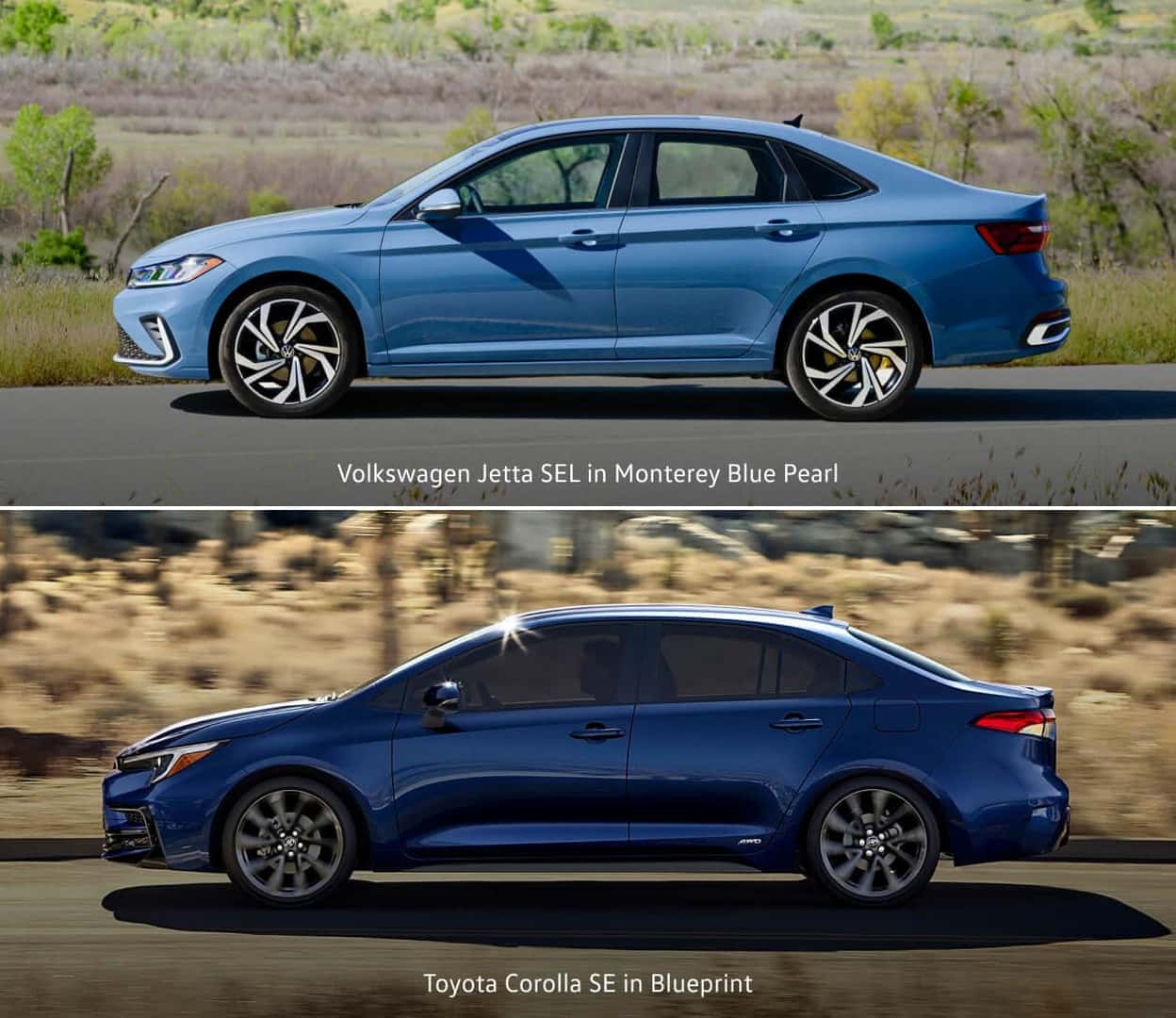
Let's check what's under the hood to explore the Jetta vs. Corolla specs side-by-side. The Volkswagen Jetta is powered by a hyper-efficient 1.5-liter four-cylinder engine that makes 158 horsepower and 184 pound-feet of torque. Available exclusively in FWD, the Jetta achieves an EPA-estimated 29/40/34 MPG (City/Highway/Combined),1 thanks to its eight-speed automatic transmission. If you want an even more capable engine, consider the new Jetta GLI for sale, which comes with a standard engine delivers up to 228 horsepower.
The Corolla is also very efficient, with a standard EPA-estimated 32/41/35 MPG (City/Highway/Combined)2 with its base engine. However, the Corolla produces 169 horsepower and just 151 pound-feet of torque, reducing overall responsiveness and merging power compared to the VW sedan. It also uses a Continuously Variable Transmission, which can be useful for its fuel economy but lacks the engaging feel and reliability of a more traditional transmission.
| Jetta vs. Corolla Engines, Side-By-Side | ||
|---|---|---|
| VW Jetta | Toyota Corolla | |
| Engine | 1.5L 4-cyl | 2.0L 4-cyl |
| Horsepower | 158 | 169 |
| Torque | 184 lb-ft | 151 lb-ft |
| Drivetrain | FWD | FWD, AWD avail |
| Fuel Tank Capacity | 13.2 gal | 13.2 gal |
| EPA-Est. MPG (Cty / Hwy / Comb) | 29 / 40 / 341 | 32 / 41 / 352 |
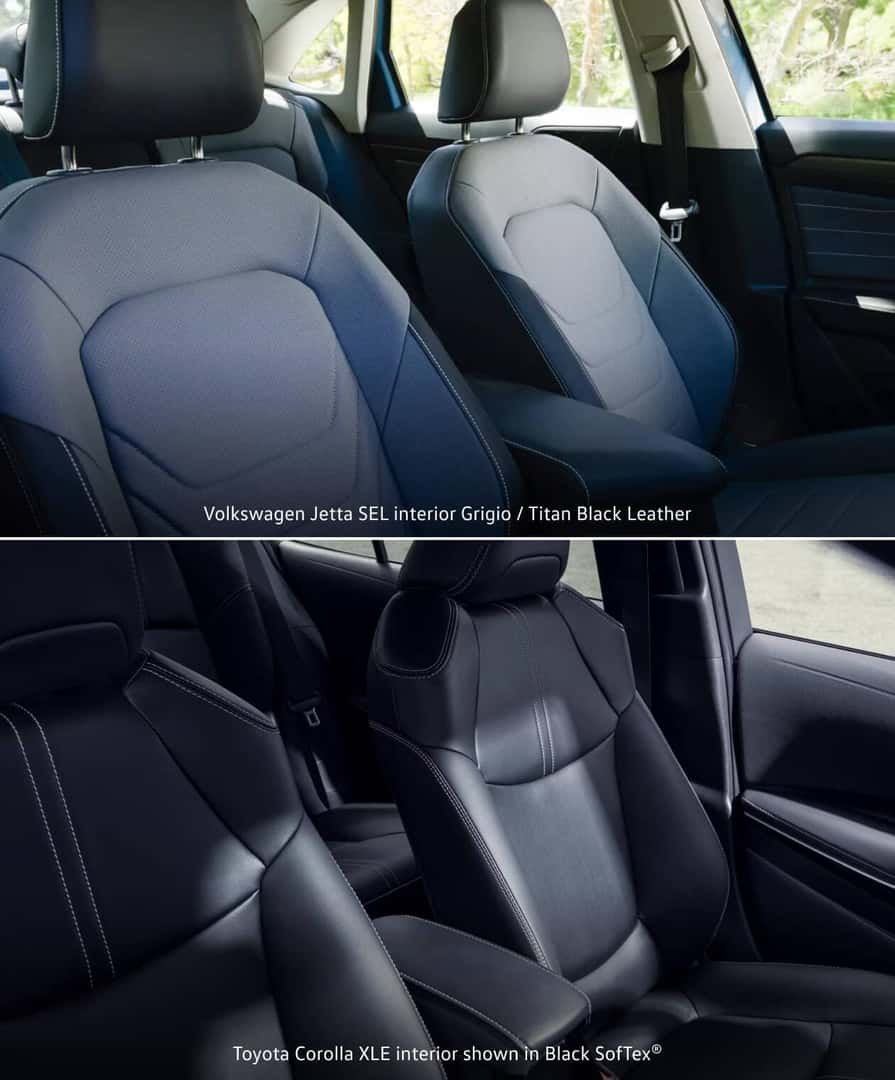
While the engines each have some wiggle room for comparison, the Jetta vs. Corolla size matchup is much more black-and-white.
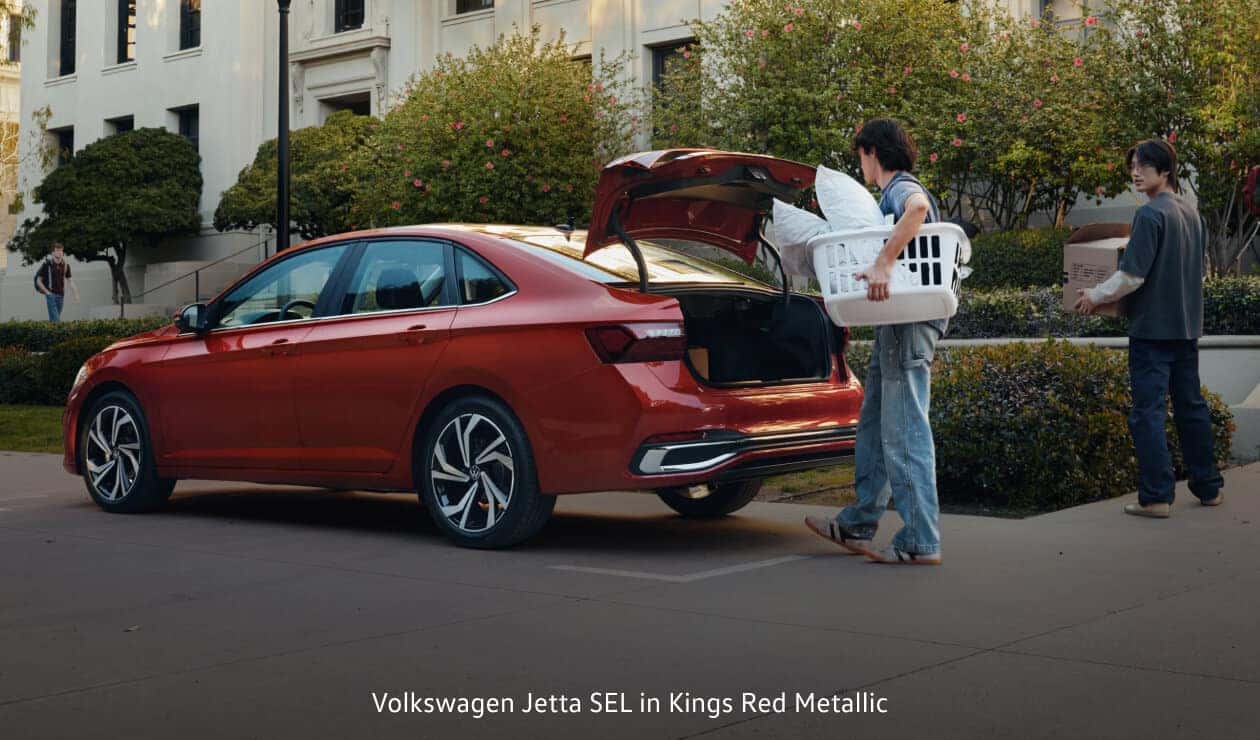
When you climb behind the wheel of a VW Jetta, you're brought into a comfortable cabin with a maximum of 94.7 cubic feet of passenger space. That's represented with 41.1 inches of front-row legroom and a massive 37.4 inches of rear-row legroom – nearly as versatile as the interior of the Toyota RAV4, let alone a Toyota sedan. The trunk of the Jetta is 14.1 cubic feet, which is plenty for groceries, errands, and even some luggage. Its length is still maneuverable, at 186.5 inches, allowing you to find parking spots even in cramped city streets easily.
The Toyota Corolla, conversely, does have 42 inches of front row legroom, but is stuck with 34.8 inches in the rear row. That's a small enough area that adults will likely start feeling a bit cramped, as will growing teens. The trunk is also just a touch smaller than its Volkswagen equivalent, sitting at 13.1 cubic feet – not a significant difference, but yet another advantage for the VW Jetta.
And it's not much smaller than the VW Jetta, either: at 182.5 inches long, the Toyota Corolla is only slightly more maneuverable, meaning you lose all that legroom and cargo space for very little benefit. So, if you're choosing between a Jetta or Corolla sedan, know that only the former offers rear-row legroom that's comfortable for friends and family.
| Jetta vs. Corolla Dimensions Comparison Chart | ||
|---|---|---|
| VW Jetta | Toyota Corolla | |
| Seating Capacity | 5 | 5 |
| Length | 186.5 in | 182.5 in |
| Width | 70.8 in | 70.1 in |
| Height | 57.7 in | 56.5 in |
| Passenger Volume |
|
88.6 cu ft |
| Legroom (Front / Rear) | 41.1 / 37.4 in | 42 / 34.8 in |
| Headroom (w/o Moonroof) (Front / Rear) | 38.5 / 37.2 in | 38.3 / 37.1 in |
| Cargo Volume | 14.1 cu ft | 13.1 cu ft |
| Ground Clearance | 5.5 in | 5.3 in |
The final piece of our Volkswagen Jetta vs. Toyota Corolla comparison touches on the warranties that come with your brand-new sedan. Both the VW Jetta and Toyota Corolla will include complimentary maintenance plans for approximately two years after purchase.3,4 However, the standard VW Jetta Limited Warranty remains in play for four years or 50,000 miles, whichever comes first, after your date of purchase.5 The Toyota Corolla will only be covered for three years or 36,000 miles, whichever comes first.6
While the Toyota Corolla certainly has an edge on fuel efficiency, the Jetta vs. Corolla competition is a clear win for the VW sedan, thanks to a stronger array of features and more rear-row legroom. Learn more information on the new VW Jetta with our team before you visit Gunther Volkswagen Fort Lauderdale.
Our current VW Jetta lease offers are sure to bring you the level of technology and comfort you and your family desire. After your contract ends, you can return the sedan or pay the agreed-upon cost – no long-term commitment required!
Yes, the Jetta is bigger than the Corolla. It measures at 186.5 inches in length, which is just a touch longer than the Corolla, which measures at 182.5 inches. Thanks to this size, your rear-row passengers get nearly 3 additional inches of legroom, and your trunk will be noticeably larger.
Yes, the VW Jetta is a very reliable vehicle. According to J.D. Power, the VW Jetta scores an 82/100 for Quality & Reliability,7 a score slightly above even a model like the Toyota Corolla, which scored an 81/100 in the same category.7
The primary difference between the VW Jetta and Toyota Corolla is size. Both models have a similar feature lineup and fuel economy, so the extra size of the Jetta stands out: your rear-row passengers have so much more room to stretch, and the trunk is significantly larger than the Toyota sedan.
Disclaimer: Published reviews may not represent all experiences of a given dealer based on the dealer’s configuration. For more information, please contact the dealer. Reviews that contain content that is untrue, illegal, obscene, threatening or a violation of any third party’s right, or contains software viruses, solicitations, political campaigns, or any form of “spam” may be removed.
| VW Jetta vs. Honda Civic | Atlas vs. Atlas Cross Sport | VW Tiguan vs. Subaru Forester |
| VW ID.4 vs. Mustang Mach-E |
129 city/40 highway mpg (2026 VW Jetta 1.5-liter four-cylinder, eight-speed automatic transmission). EPA estimates. Your mileage will vary and depends on several factors, including your driving habits and vehicle condition.
2Use for comparison purposes only. Your mileage will vary for many reasons, including your vehicle's condition and how/where you drive. See www.fueleconomy.gov.
3Carefree Coverage available on all new MY26 vehicles. For vehicle eligibility details, visit vw.com/coverage. VW's Carefree Maintenance Program provides 10,000- and 20,000-mile scheduled maintenance services or scheduled maintenance services for two years (whichever occurs first) as stated in the vehicle's maintenance booklet. Does not include tire rotations, or other services or parts not specified in the owner's literature. 3 years/36,000 miles (whichever occurs first) Roadside Assistance provided by a third party. 4 years/50,000 miles (whichever occurs first) New Vehicle Limited Warranty. See owner's literature or dealer for warranty, maintenance program, and roadside assistance details, exclusions, and limitations. Car-Net Remote Access services require cellular connectivity, GPS signal, and acceptance of Terms of Service. Not all Car-Net services and features are available on all vehicles. Other Car-Net services require a trial or paid subscription. See additional important information at carnet.vw.com.
4ToyotaCare covers normal factory scheduled maintenance for 2 years or 25,000 miles, whichever comes first, and 24/7 Roadside Assistance is for 2 years/unlimited mileage (note: ToyotaCare for Mirai is 3 years/35,000 miles and Roadside Assistance for Mirai, bZ4X, Prius, and Prius Prime is 3 years/unlimited mileage). Roadside Assistance does not include parts and fluids, except limited emergency gas delivery. Towing distance up to 25 miles. Restrictions apply. Available in the continental U.S. and Canada. See Toyota dealer for details and exclusions.
54 years/50,000 miles (whichever occurs first) New Vehicle Limited Warranty on all new MY26 vehicles. See owner's literature or dealer for warranty exclusions and limitations.
6Date and mileage limitations refer to whichever occurs first from the date of purchase. Warranty coverage is subject to other terms and conditions. Refer to applicable Warranty and Maintenance Guide for full details.
7Reference to this third-party claim is solely for informational purposes and not to be relied upon. For details regarding this rating, visit https://www.jdpower.com/cars/



